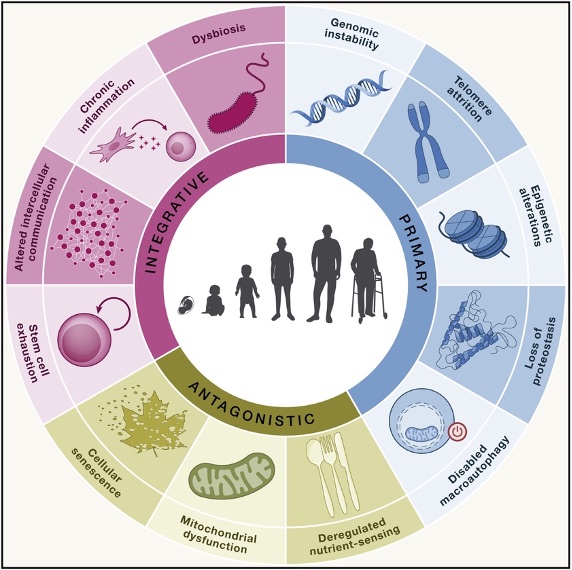
1. Genomic instability
DNA accumulates mutations, double-strand breaks, oxidative damage, mitochondrial DNA damage and impaired DNA repair.
🟢 Ways to mitigate: Avoid tobacco/excessive UV; exercise at least 3x a week; adequate folate/B12/choline and other micronutrients. 🟡 NAD⁺ precursors such as NMN/NR may support NAD-dependent DNA-repair pathways, Telomerase/gene therapy and partial reprogramming remain experimental.
Alcohol use: Negative impact
Ethanol metabolism produces acetaldehyde and ROS, which damages DNA. Alcohol also changes NAD⁺/NADH metabolism and cellular redox state. Alcohol uses 20% of available NAD to metabolize thus reducing available NAD needed for energy/DNA repair.
2. Telomere attrition
Chromosome ends progressively shorten and eventually trigger DNA-damage responses and cellular senescence.
🟢 Exercise, adequate sleep and avoid smoking. Correct nutritional deficiencies. Telomerase activation is theoretically powerful but carries a major cancer concern; no supplement has convincingly been shown to safely reverse telomere aging.
Alcohol use: Negative impact
A systematic review found shorter telomeres in people with alcohol use.
3. Epigenetic alterations
DNA methylation, histone modifications and chromatin organization become increasingly disordered, producing inappropriate gene expression—the basis for concepts such as the epigenetic clock.
🟢 Exercise, healthy diet, sleep and metabolic health. 🟡 NMN/NR, spermidine and other NAD/autophagy-oriented approaches may influence epigenetic machinery, but they aren’t proven “epigenetic rejuvenators.” 🔴 Partial epigenetic reprogramming (OSK/OSKM) is experimental.
Alcohol use: Clearly negative with chronic/heavy exposure. Alcohol changes DNA methylation, histone acetylation/methylation and microRNA expression. Alcohol dependence has also been associated with accelerated epigenetic age in some tissues.
4. Loss of proteostasis
The cell becomes less capable of correctly folding, repairing and removing damaged proteins. Misfolded/aggregated proteins accumulate.
🟢 Resistance training, adequate protein, good metabolic health, adequate autophagy, spermidine and possibly urolithin A. 🔴 Pharmacologic proteostasis enhancers/chaperone therapies remain experimental.
Alcohol use: Negative. Chronic alcohol can impair protein synthesis/degradation, increase oxidative/ER stress and contribute to accumulation of damaged proteins.
5. Disabled macroautophagy
The cellular recycling system becomes less efficient at removing damaged proteins, lipids and organelles—including damaged mitochondria.
🟢 Exercise and periodic energy restriction/fasting can stimulate autophagy. 🟡 Spermidine and urolithin A are interesting; urolithin A has human data showing changes in mitochondrial/autophagy-related markers. 🔴 Rapamycin is a powerful experimental mTOR/autophagy intervention but isn’t established as an anti-aging drug.
Alcohol use: chronic/binge exposure can impair autophagic flux, particularly in the liver. Alcohol-related mTOR/TFEB changes can interfere with lysosomal function.
6. Deregulated nutrient-sensing
Insulin/IGF-1, mTOR, AMPK, sirtuins and related pathways become chronically biased toward growth/storage rather than repair/recycling.
🟢 Exercise, healthy body composition, avoiding chronic caloric excess. 🟢 Treat insulin resistance/obesity if present. 🟡 Metformin has interesting geroscience data but isn’t established as an anti-aging drug for healthy people. 🔴 Rapamycin/mTOR inhibition is promising but experimental.
Negative, particularly chronic use. Alcohol provides substantial calories, alters hepatic glucose/lipid metabolism and interferes with insulin, AMPK and mTOR signaling.
7. Mitochondrial dysfunction
Mitochondria become less efficient, produce more ROS, accumulate mtDNA damage and lose the ability to maintain energy production.
🟢 Resistance + aerobic exercise are probably the strongest interventions. 🟢 Adequate protein/creatine. 🟡 Urolithin A has human data showing mitochondrial gene-expression changes and modest muscle benefits. 🟡 CoQ10 may help when deficient or in specific conditions, but isn’t established as an anti-aging treatment. 🟡 NMN/NR raises NAD⁺
Strongly negative with chronic/high intake. Alcohol metabolism generates ROS and can impair mitochondrial protein synthesis, ATP production, oxidative capacity and glutathione handling.
8. Cellular senescence
Damaged cells permanently stop dividing but remain metabolically active and release SASP factors—IL-6, IL-1β, TNF-α, MMPs and others—that damage surrounding tissue.
🟢 Exercise/metabolic health reduce drivers of senescence. 🟡 Senolytics such as fisetin and the dasatinib/quercetin concept are highly interesting. 🔴 Human evidence is still insufficient to recommend routine senolytic therapy for longevity. Fisetin has many human trials underway, but its ability to selectively eliminate senescent cells in humans remains unproven.
Alcohol use: Negative impact. Alcohol-induced oxidative stress, mitochondrial dysfunction, DNA damage and inflammation can create conditions favoring cellular senescence. (Zombie cells) The strongest evidence is preclinical/tissue-specific rather than proving that every drink directly increases whole-body senescent-cell burden.
9. Stem-cell exhaustion
Tissue-specific stem/progenitor cells lose quantity, proliferative capacity or regenerative environment. Muscle, hematopoietic, intestinal, neural and other stem-cell compartments are affected.
🟢 Resistance training, aerobic exercise, adequate protein and micronutrients. 🟡 Optimizing systemic inflammation/metabolic health. 🔴 Stem-cell transplantation, exosomes and MSC therapies are being investigated, but there is no established systemic stem-cell treatment that rejuvenates healthy humans.
Negative. Chronic alcohol can damage tissue stem/progenitor environments, particularly liver, muscle and hematopoietic systems, while inflammation and oxidative stress make the regenerative environment less favorable.
10. Altered intercellular communication
Endocrine, nervous, immune and paracrine signaling becomes increasingly dysregulated. This includes insulin/IGF-1, sex hormones, neurotransmitters, cytokines and extracellular signaling.
🟢 Exercise, sleep, metabolic health. 🟢 Correct genuine hormone deficiencies. 🟡 HRT/TRT when there is documented deficiency and appropriate indication can restore physiological signaling, but isn’t a general anti-aging therapy.
Negative. Alcohol alters neuroendocrine signaling, immune signaling and hormone metabolism. Chronic use can disrupt testosterone/estrogen/cortisol and growth-related pathways.
11. Chronic inflammation
The immune system shifts toward persistent low-grade inflammatory signaling—“inflammaging.” This is one of the central amplifiers of the other hallmarks.
🟢 Exercise, healthy weight, Mediterranean-style diet, adequate sleep, oral health, treating chronic infections/metabolic disease. 🟡 Omega-3s, curcumin and other anti-inflammatory compounds may have modest effects. 🔴 Rapamycin/metformin/anti-inflammatory drugs are being investigated as geroscience interventions.
Alcohol use: One of alcohol’s strongest effects. Alcohol promotes gut permeability, endotoxin translocation, immune activation and systemic inflammation.
12. Dysbiosis
The composition and function of the gut microbiome becomes less diverse/less favorable, altering metabolites, immune signaling and gut-barrier integrity.
🟢 High-fiber plant-rich diet, exercise, adequate fermented foods. 🟡 Prebiotics/probiotics/synbiotics and possibly targeted microbiome therapies. 🟡 Fecal microbiota transplantation is being investigated for specific diseases, not established as an anti-aging treatment.


Leave a Reply